Intelligence is getting cheaper. Our expectations aren’t.
The price of a fixed level of AI is falling about thirteen times a year, far faster than computing or batteries got cheaper. Our AI bills are going up anyway. Both are true, and they are the same story.
In March 2023, the best AI model you could buy was GPT-4, at $37.50 per million tokens. Eighteen months later, a model just as good cost thirteen cents. That is 286 times cheaper.1
If cars did that, a ₹10 lakh car would cost about ₹3,500 a year and a half later.
And yet hardly anyone feels that AI got cheap. Simon Willison, a programmer who writes about AI models almost every day, pays $200 a month for two AI subscriptions. At list prices, his last thirty days would have cost $2,180.2 Companies feel it too. This year Uber spent its whole annual AI budget in four months, and Salesforce expects to pay Anthropic about $300 million.3
So which is it? Both. Intelligence keeps getting cheaper. What we expect of it keeps getting more expensive. The moment a level of intelligence becomes cheap, we stop wanting it. We want the next level, and a lot more of it.
What you are paying for
AI companies charge by the token, a chunk of text that is usually part of a word. “Cheap” is one token; “unaffordable” is three. In English, a thousand tokens is about 750 words.
Prices are quoted per million tokens, with one price for what you send and a higher one for what the model writes back. When this note gives a single price, it blends three parts input to one part output, a common convention among price trackers.4
Part one
Intelligence is getting cheaper
Here is that drop step by step. At each point since GPT-4 launched, this is the cheapest model, open or closed, that does at least as well.
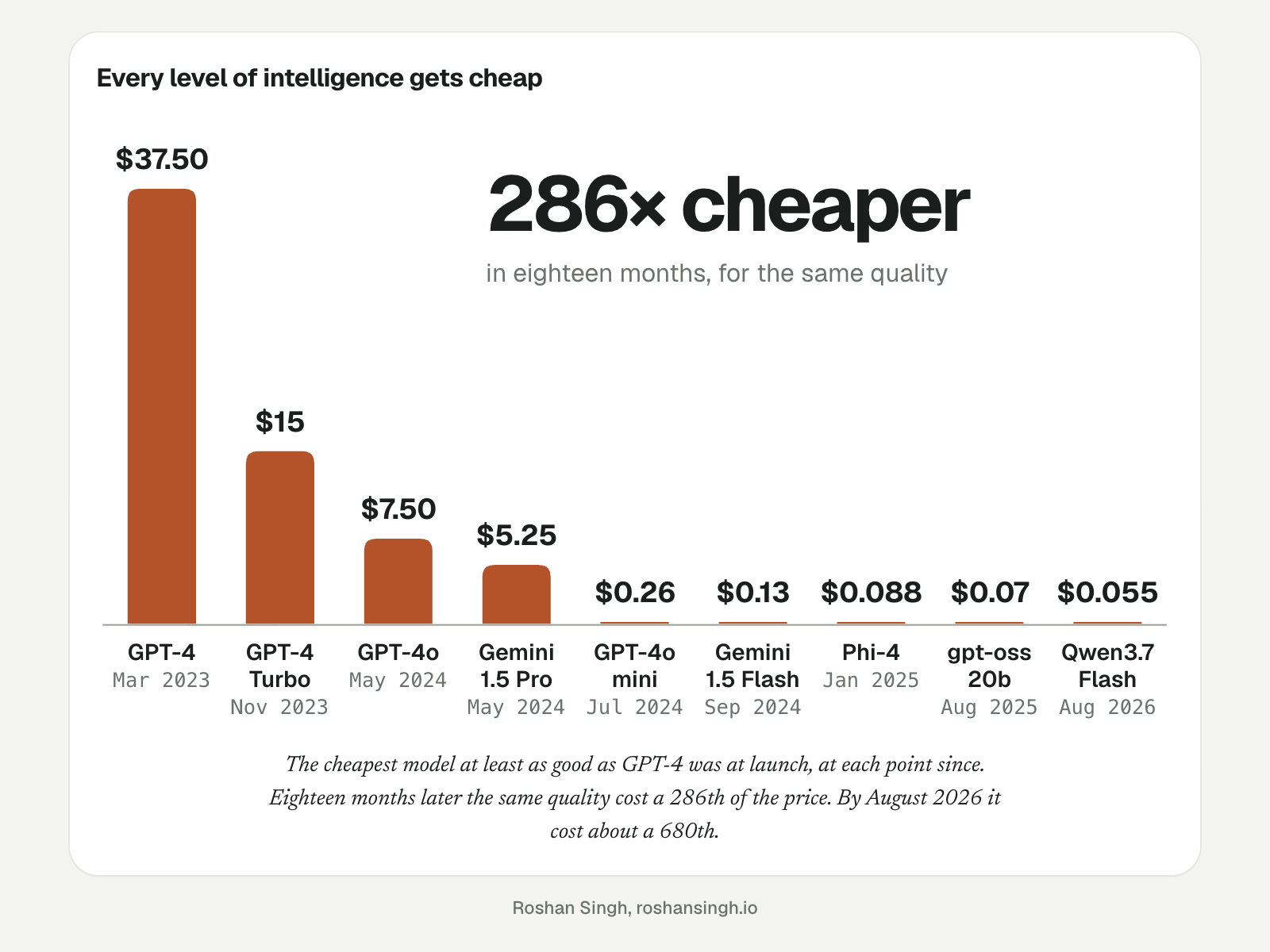
- As good as GPT-4
- 65% on GPQA, what PhD experts score
- 90% on GPQA
Sources and numbers
148 model versions from 13 labs, open and closed. Open-weight models are priced at their maker’s API or the cheapest of four big hosts (Together, Fireworks, DeepInfra, Groq), whichever is lower. Each point is a new low; later price rises, like DeepSeek’s in August 2026, aren’t shown. Blended price, three parts input to one part output, from each lab’s list prices. “As good as GPT-4” means at least GPT-4’s score on GPQA Diamond (35.7%) and on Epoch’s Capabilities Index. Scores: Epoch AI, best published setting.
| Model | Price date | Price per million tokens | GPQA Diamond |
|---|---|---|---|
| GPT-4 | Mar 2023 | $37.50 | 36% |
| GPT-4 Turbo | Nov 2023 | $15 | 42% |
| GPT-4o | May 2024 | $7.50 | 49% |
| Gemini 1.5 Pro | May 2024 | $5.25 | 46% |
| GPT-4o mini | Jul 2024 | $0.26 | 38% |
| Gemini 1.5 Flash | Sep 2024 | $0.13 | 47% |
| o1 | Dec 2024 | $26.25 | 77% |
| Phi-4 (on DeepInfra) | Jan 2025 | $0.088 | 56% |
| DeepSeek-R1 | Jan 2025 | $0.96 | 69% |
| Llama 4 Maverick (on DeepInfra) | Apr 2025 | $0.30 | 67% |
| QwQ-32B (on DeepInfra) | Apr 2025 | $0.16 | 65% |
| Qwen3-32B (on DeepInfra) | May 2025 | $0.15 | 66% |
| gpt-oss-20b (on DeepInfra) | Aug 2025 | $0.07 | 61% |
| GPT-5 nano | Aug 2025 | $0.14 | 69% |
| Gemini 3 Pro | Nov 2025 | $4.50 | 93% |
| Kimi K2.6 | Apr 2026 | $1.71 | 91% |
| MiniMax-M3 | Jun 2026 | $1.05 | 91% |
| DeepSeek-V4-Pro | Jun 2026 | $0.54 | 91% |
| GPT-5.6 Luna | Jul 2026 | $0.45 | 92% |
| DeepSeek-V4-Flash | Jul 2026 | $0.18 | 91% |
| Qwen3.7-Flash | Aug 2026 | $0.055 | 82% |
In everyday terms: having GPT-4 proofread a 300-page book in 2023 cost about $11. With GPT-6 Luna, which scores far higher, it costs about seven cents.5 Then something more interesting happened: hardly anyone took the savings. When a better model comes out, most teams move to it within weeks instead of saving money on the old level.6
Switch the chart to “Every level” and you see the pattern repeat. In Epoch’s tests, the first model to score 65% on GPQA Diamond, about what PhD experts score in their own fields, was OpenAI’s o1 in December 2024, at $26.25 per million tokens. Four months later Alibaba’s open model QwQ-32B did it for about 16 cents on DeepInfra, a hosting service. The first model to pass 90% cost $4.50 in November 2025; eight months later DeepSeek’s V4-Flash did it for about 18 cents. GPT-4’s level kept falling too: by August 2026 Alibaba’s Qwen3.7-Flash beat it for about five and a half cents, nearly 700 times less than GPT-4.1
Epoch AI, a research group that tracks this closely, measured the full cost of reaching a given score, including all the thinking a model does before it answers. Across five benchmarks it falls about 47% every quarter, roughly thirteen times a year. By their reckoning that is six times faster than the long-run fall in the cost of computing, and eighteen times faster than batteries.7
Smarter and cheaper at the same time
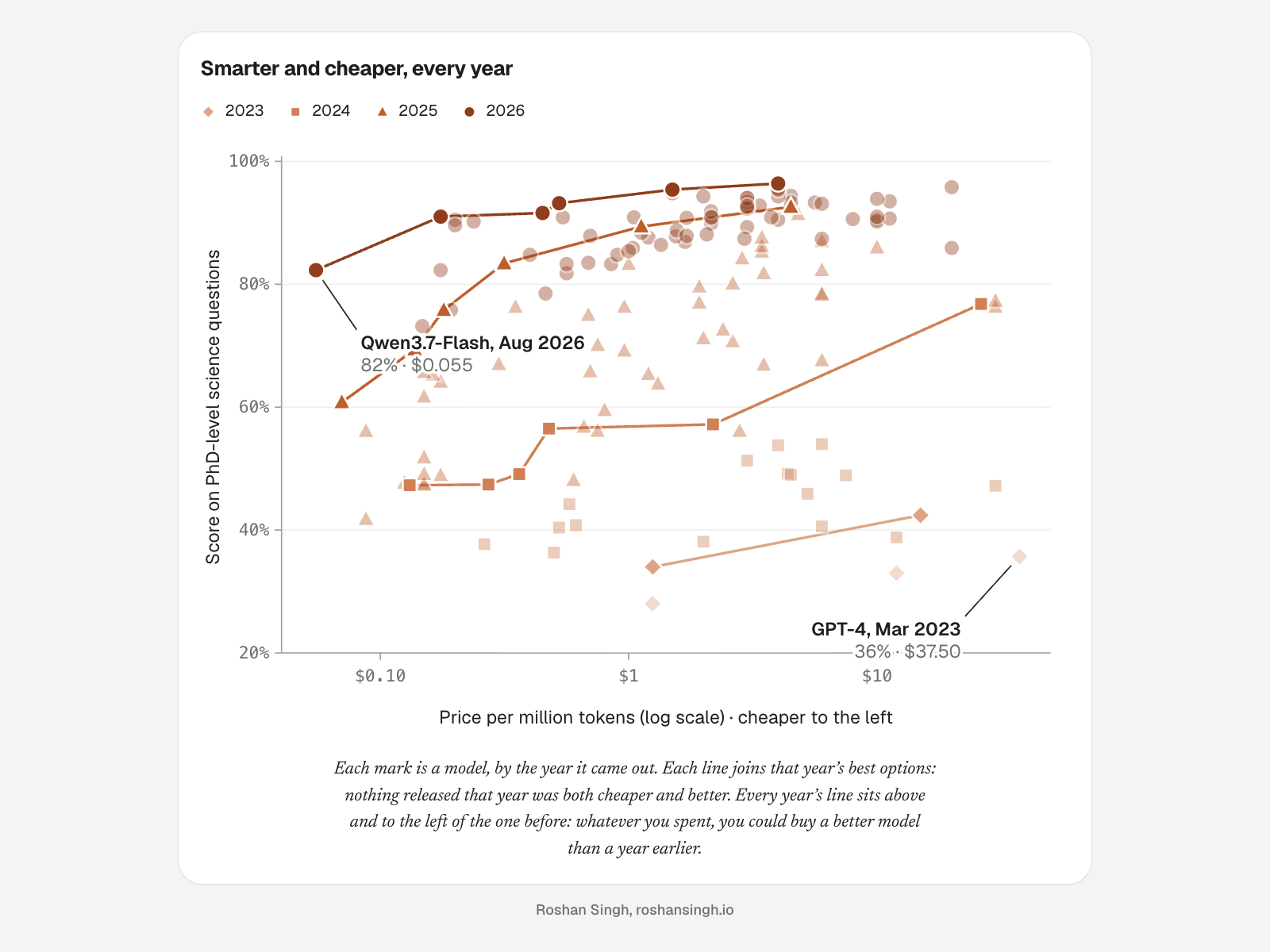
Holding quality fixed undersells it, because quality didn’t stay fixed. Plot 148 model versions from 13 labs, open and closed, by how capable they are and what they cost, and each year’s best options sit higher and further to the left than the year before. Whatever you spent, you could buy a better model than a year earlier.
- 2023
- 2024
- 2025
- 2026
- 2023
- 2024
- 2025
- 2026
Sources and numbers
148 model versions from 13 labs, open and closed. Open-weight models are priced at their maker’s API or the cheapest of four big hosts (Together, Fireworks, DeepInfra, Groq), whichever is lower. Blended list price, three parts input to one part output. Scores: Epoch AI (GPQA Diamond, best published setting; Epoch Capabilities Index, which combines many benchmarks). Reasoning settings use more tokens per answer than this per-token price shows. Gemini 3.7 Flash, 3.8 Flash and 4 Argon are at their introductory prices.
| Model | Price date | Price per million tokens | GPQA Diamond | Capabilities Index |
|---|---|---|---|---|
| GPT-4 | Mar 2023 | $37.50 | 36% | 125.74 |
| GPT-3.5 Turbo | Nov 2023 | $1.25 | 28% | 118.53 |
| GPT-4 Turbo | Nov 2023 | $15 | 42% | 126.43 |
| Claude 2.1 | Nov 2023 | $12 | 33% | 119.32 |
| Gemini 1.0 Pro | Dec 2023 | $1.25 | 34% | 117.14 |
| Mistral Large | Feb 2024 | $12 | 39% | 122.12 |
| Claude 3 Opus | Mar 2024 | $30 | 47% | 126.9 |
| Claude 3 Sonnet | Mar 2024 | $6 | 41% | 120.84 |
| Claude 3 Haiku | Mar 2024 | $0.50 | 36% | 118.85 |
| GPT-4o | May 2024 | $7.50 | 49% | 128.99 |
| Gemini 1.5 Pro | May 2024 | $5.25 | 46% | 126.94 |
| Gemini 1.5 Flash | May 2024 | $0.53 | 40% | 122.68 |
| Claude 3.5 Sonnet | Jun 2024 | $6 | 54% | 130 |
| Qwen2-72B (on DeepInfra) | Jun 2024 | $0.61 | 41% | 125.28 |
| GPT-4o mini | Jul 2024 | $0.26 | 38% | 126.46 |
| Mistral Large 2 | Jul 2024 | $4.50 | 49% | 127.57 |
| Llama 3.1 70B (on DeepInfra) | Aug 2024 | $0.58 | 44% | 125.93 |
| GPT-4o | Aug 2024 | $4.38 | 49% | 128.83 |
| Gemini 1.5 Flash | Sep 2024 | $0.13 | 47% | 129.33 |
| Gemini 1.5 Pro | Oct 2024 | $2.19 | 57% | 131.72 |
| Qwen2.5-72B (on DeepInfra) | Oct 2024 | $0.36 | 49% | 128.97 |
| Claude 3.5 Haiku | Nov 2024 | $2 | 38% | 127.07 |
| Mistral Large 2 | Nov 2024 | $3 | 51% | 128.57 |
| Llama 3.3 70B (on DeepInfra) | Dec 2024 | $0.27 | 47% | 127.33 |
| Grok 2 | Dec 2024 | $4 | 54% | 130.47 |
| o1 | Dec 2024 | $26.25 | 77% | 141.72 |
| DeepSeek-V3 | Dec 2024 | $0.48 | 57% | 132.3 |
| Phi-4 (on DeepInfra) | Jan 2025 | $0.088 | 56% | 130.48 |
| DeepSeek-R1 | Jan 2025 | $0.96 | 69% | 138.82 |
| o3-mini | Jan 2025 | $1.93 | 77% | 140.2 |
| Qwen-Turbo | Jan 2025 | $0.088 | 42% | – |
| Qwen-Plus | Jan 2025 | $0.60 | 48% | – |
| Qwen2.5-Max | Jan 2025 | $2.80 | 56% | 132.48 |
| Mistral Small 3 | Feb 2025 | $0.15 | 47% | – |
| Gemini 2.0 Flash | Feb 2025 | $0.18 | 64% | 134.62 |
| Claude 3.7 Sonnet | Feb 2025 | $6 | 79% | 141.03 |
| Gemma 3 27B (on DeepInfra) | Mar 2025 | $0.13 | 48% | 129.97 |
| Llama 4 Maverick (on DeepInfra) | Apr 2025 | $0.30 | 67% | 132.22 |
| Llama 4 Scout (on DeepInfra) | Apr 2025 | $0.15 | 52% | 129.63 |
| QwQ-32B (on DeepInfra) | Apr 2025 | $0.16 | 65% | 137.5 |
| Grok 3 | Apr 2025 | $6 | 68% | 138.21 |
| Grok 3 mini | Apr 2025 | $0.35 | 76% | 140.2 |
| GPT-4.1 | Apr 2025 | $3.50 | 67% | 136.65 |
| GPT-4.1 mini | Apr 2025 | $0.70 | 66% | 134.89 |
| GPT-4.1 nano | Apr 2025 | $0.18 | 49% | 129.54 |
| o4-mini | Apr 2025 | $1.93 | 80% | 145.46 |
| QwQ-Plus | Apr 2025 | $1.20 | 65% | – |
| Mistral Medium 3 | May 2025 | $0.80 | 60% | 134.02 |
| Qwen3-32B (on DeepInfra) | May 2025 | $0.15 | 66% | 138.42 |
| Qwen3-30B-A3B (on DeepInfra) | May 2025 | $0.15 | 62% | 136.11 |
| Qwen3-235B-A22B | May 2025 | $2.63 | 71% | 139.15 |
| Qwen3-14B | May 2025 | $1.31 | 64% | 138.15 |
| Qwen3-8B | May 2025 | $0.66 | 57% | 136.06 |
| Claude Opus 4 | May 2025 | $30 | 76% | 142.52 |
| Claude Sonnet 4 | May 2025 | $6 | 78% | 141.56 |
| Mistral Small 3.1 | May 2025 | $0.15 | 48% | 127.53 |
| DeepSeek-R1 | May 2025 | $0.96 | 76% | 141.13 |
| o3 | Jun 2025 | $3.50 | 82% | 146.73 |
| Gemini 2.5 Pro | Jun 2025 | $3.44 | 85% | 145.13 |
| Magistral Small | Jun 2025 | $0.75 | 56% | 133.07 |
| Grok 4 | Jul 2025 | $6 | 87% | 146.24 |
| Mistral Small 3.2 | Jul 2025 | $0.15 | 49% | – |
| Qwen3-235B-A22B Thinking | Aug 2025 | $2.63 | 80% | 143.76 |
| Qwen3-30B-A3B Thinking | Aug 2025 | $0.75 | 70% | 139.55 |
| Claude Opus 4.1 | Aug 2025 | $30 | 77% | 144.07 |
| gpt-oss-120b (on DeepInfra) | Aug 2025 | $0.18 | 76% | 139.79 |
| gpt-oss-20b (on DeepInfra) | Aug 2025 | $0.07 | 61% | 137.7 |
| GPT-5 | Aug 2025 | $3.44 | 86% | 150 |
| GPT-5 mini | Aug 2025 | $0.69 | 75% | 145.34 |
| GPT-5 nano | Aug 2025 | $0.14 | 69% | 139.21 |
| Claude Sonnet 4.5 | Sep 2025 | $6 | 82% | 146.74 |
| Qwen3-Max | Oct 2025 | $2.40 | 73% | 142.33 |
| Claude Haiku 4.5 | Oct 2025 | $2 | 71% | 142.15 |
| Kimi K2 Thinking Turbo | Nov 2025 | $2.86 | 84% | – |
| GPT-5.1 | Nov 2025 | $3.44 | 88% | 149.76 |
| Gemini 3 Pro | Nov 2025 | $4.50 | 93% | 153.07 |
| Claude Opus 4.5 | Nov 2025 | $10 | 86% | 150.11 |
| DeepSeek-V3.2 | Dec 2025 | $0.32 | 83% | 146.09 |
| GPT-5.2 | Dec 2025 | $4.81 | 91% | 153.66 |
| Gemini 3 Flash | Dec 2025 | $1.13 | 89% | 151.88 |
| GLM-4.7 | Dec 2025 | $1 | 83% | 143.59 |
| Kimi K2.5 | Jan 2026 | $1.20 | 88% | 148.07 |
| Claude Opus 4.6 | Feb 2026 | $10 | 91% | 155.66 |
| GLM-5 | Feb 2026 | $1.55 | 88% | 145.8 |
| Claude Sonnet 4.6 | Feb 2026 | $6 | 87% | 152.79 |
| Qwen3.5-397B-A17B | Feb 2026 | $1.35 | 86% | 146.8 |
| Qwen3.5-Plus | Feb 2026 | $0.90 | 85% | 146.17 |
| Gemini 3.1 Pro | Feb 2026 | $4.50 | 94% | 155.34 |
| Qwen3.5-35B-A3B | Mar 2026 | $0.69 | 84% | 142.49 |
| Qwen3.5-Flash | Mar 2026 | $0.18 | 82% | 143.52 |
| Gemini 3.1 Flash-Lite | Mar 2026 | $0.56 | 82% | 144.26 |
| GPT-5.4 | Mar 2026 | $5.63 | 93% | 157.31 |
| Grok 4.20 | Mar 2026 | $3 | 89% | 152.11 |
| GPT-5.4 nano | Mar 2026 | $0.46 | 79% | 146.03 |
| GPT-5.4 mini | Mar 2026 | $1.69 | 87% | 148.7 |
| Gemma 4 31B (on DeepInfra) | Apr 2026 | $0.19 | 76% | 142.99 |
| Gemma 4 26B (on DeepInfra) | Apr 2026 | $0.15 | 73% | 141.88 |
| GLM-5.1 | Apr 2026 | $2.15 | 90% | 149.82 |
| Claude Opus 4.7 | Apr 2026 | $10 | 90% | 156.79 |
| Qwen3.6-Plus | Apr 2026 | $1.13 | 88% | 147.3 |
| Kimi K2.6 | Apr 2026 | $1.71 | 91% | 150.94 |
| DeepSeek-V4-Pro | Apr 2026 | $2.18 | 91% | 149.13 |
| GPT-5.5 | Apr 2026 | $11.25 | 91% | 159.68 |
| Qwen3.6-35B-A3B (on DeepInfra) | Apr 2026 | $0.40 | 85% | 143.73 |
| Qwen3.6-Flash | Apr 2026 | $0.56 | 83% | 142.89 |
| Grok 4.3 | Apr 2026 | $1.56 | 89% | 148.81 |
| Qwen3.6-27B (on DeepInfra) | May 2026 | $1.04 | 86% | 146.23 |
| Gemini 3.5 Flash | May 2026 | $3.38 | 93% | 154.88 |
| Claude Opus 4.8 | May 2026 | $10 | 91% | 159.01 |
| Qwen3.6-Max Preview | Jun 2026 | $2.93 | 87% | 149.41 |
| Qwen3.7-Max | Jun 2026 | $3.75 | 91% | 154.04 |
| MiniMax-M3 | Jun 2026 | $1.05 | 91% | 146.87 |
| Nemotron 3 Ultra (on DeepInfra) | Jun 2026 | $1 | 85% | 145.97 |
| Claude Fable 5 | Jun 2026 | $20 | 86% | 163.42 |
| DeepSeek-V4-Pro | Jun 2026 | $0.54 | 91% | 149.13 |
| Kimi K2.7 Code | Jun 2026 | $1.71 | 88% | 150.11 |
| GLM-5.2 | Jun 2026 | $2.15 | 92% | 151.94 |
| Claude Sonnet 5 | Jun 2026 | $4 | 91% | 156.88 |
| GPT-5.6 Sol | Jul 2026 | $11.25 | 94% | 162.79 |
| Grok 4.5 | Jul 2026 | $3 | 93% | 154.07 |
| Qwen3.7-Plus | Jul 2026 | $0.70 | 88% | 147 |
| Kimi K3 | Jul 2026 | $6 | 93% | 157.86 |
| Gemini 3.6 Flash | Jul 2026 | $3 | 94% | 154.53 |
| Gemini 3.5 Flash-Lite | Jul 2026 | $0.85 | 83% | 144.91 |
| Claude Opus 5 | Jul 2026 | $10 | 94% | 163.94 |
| GPT-5.6 Luna | Jul 2026 | $0.45 | 92% | 156.5 |
| GPT-5.6 Terra | Jul 2026 | $4.50 | 93% | 160.09 |
| DeepSeek-V4-Flash | Jul 2026 | $0.18 | 91% | – |
| Qwen3.7-Flash | Aug 2026 | $0.055 | 82% | 144.05 |
| Qwen3.8-Max | Aug 2026 | $3 | 93% | 157.4 |
| Grok 4.6 | Aug 2026 | $3 | 94% | 156.57 |
| Gemini 3.7 Flash | Aug 2026 | $1.50 | 95% | 157.97 |
| GLM-5.3 | Aug 2026 | $2.15 | 91% | 155.99 |
| GLM-5.3-Flash | Aug 2026 | $0.24 | 90% | 153.08 |
| Gemini 3.8 Flash | Sep 2026 | $1.50 | 95% | 157.44 |
| GPT-6 Astra | Sep 2026 | $20 | 96% | 168.81 |
| Qwen3.8-Max | Sep 2026 | $3 | 92% | 155.08 |
| GPT-6 Sol | Sep 2026 | $4 | 94% | 163.73 |
| GPT-6 Luna | Sep 2026 | $0.20 | 91% | 156.75 |
| Claude Opus 5.5 | Sep 2026 | $8 | 91% | 168.83 |
| Grok 4.7 | Sep 2026 | $3 | 93% | 154.37 |
| Claude Sonnet 5.5 | Sep 2026 | $4 | 96% | 166.18 |
| GPT-6.1 Sol | Sep 2026 | $4 | 95% | 168.37 |
| Mistral Large 4 | Oct 2026 | $2.07 | 88% | 150.03 |
| Claude Haiku 5.5 | Oct 2026 | $0.20 | 90% | 159.32 |
| Gemini 4 Argon | Oct 2026 | $4 | 96% | 166.45 |
| DeepSeek-V4.1-Flash | Oct 2026 | $0.53 | 93% | – |
| GPT-6.1 Terra | Oct 2026 | $2 | 94% | – |
Here is the same thing as a report card: GPT-4 next to the smallest and the largest of OpenAI’s newest models.
GPT-4 against today’s models
| Measure | GPT-4Mar 2023 | GPT-6 LunaSep 2026 · smallest GPT-6 | GPT-6 AstraSep 2026 · OpenAI’s best |
|---|---|---|---|
| PhD-level scienceGPQA Diamond | 35.7% | 90.5% | 95.8% |
| Broad capabilityEpoch Capabilities Index | 125.7 | 156.8 | 168.8 |
| Price per million tokensinput / output | $30 / $60 | $0.10 / $0.50 | $10 / $50 |
Source
Scores: Epoch AI independent runs, best published setting. Prices: OpenAI list prices at launch.
Why it keeps falling
Big models teach small ones. A small model is trained to imitate a large one, and ends up nearly as good for a fraction of the cost. Google says it made Gemini 1.5 Flash this way.
Models use only the part they need. DeepSeek-V3 has 671 billion parameters but uses about 37 billion for each token, like a hospital that sends you to a few specialists instead of every doctor.8
Repeated work gets reused. Instructions that arrive again and again are processed once and stored, and OpenAI charges as little as a tenth of the normal price for them.9
Competition. In January 2025 DeepSeek’s open model R1 came close to OpenAI’s o1 at about a twenty-seventh of the price. Nvidia lost $589 billion of value in a day, and that June OpenAI cut the price of o3 by 80%.10 Open models add to the pressure: anyone can run them, so hosts compete on price. A day after OpenAI released its own open model, gpt-oss-20b, DeepInfra was selling it for about 7 cents.11
Part two
Our expectations aren’t
If prices fell this fast, why are bills going up? Because nobody buys a fixed level of intelligence. We buy the newest good model, we use it as much as we now want to, and the best model is never the cheap one.
In 1865 the economist William Stanley Jevons noticed the same thing about coal. Engines got far more efficient, and Britain burned more coal than ever, because cheap power found new uses. “It is the very economy of its use which leads to its extensive consumption,” he wrote.12
Light is the clearest example. In Britain it became more than 3,000 times cheaper between 1800 and 2000, and each person used 6,500 times more of it. So people ended up spending more on light, not less.13
AI is doing the same thing in about three years, in four ways.
We want the newest model
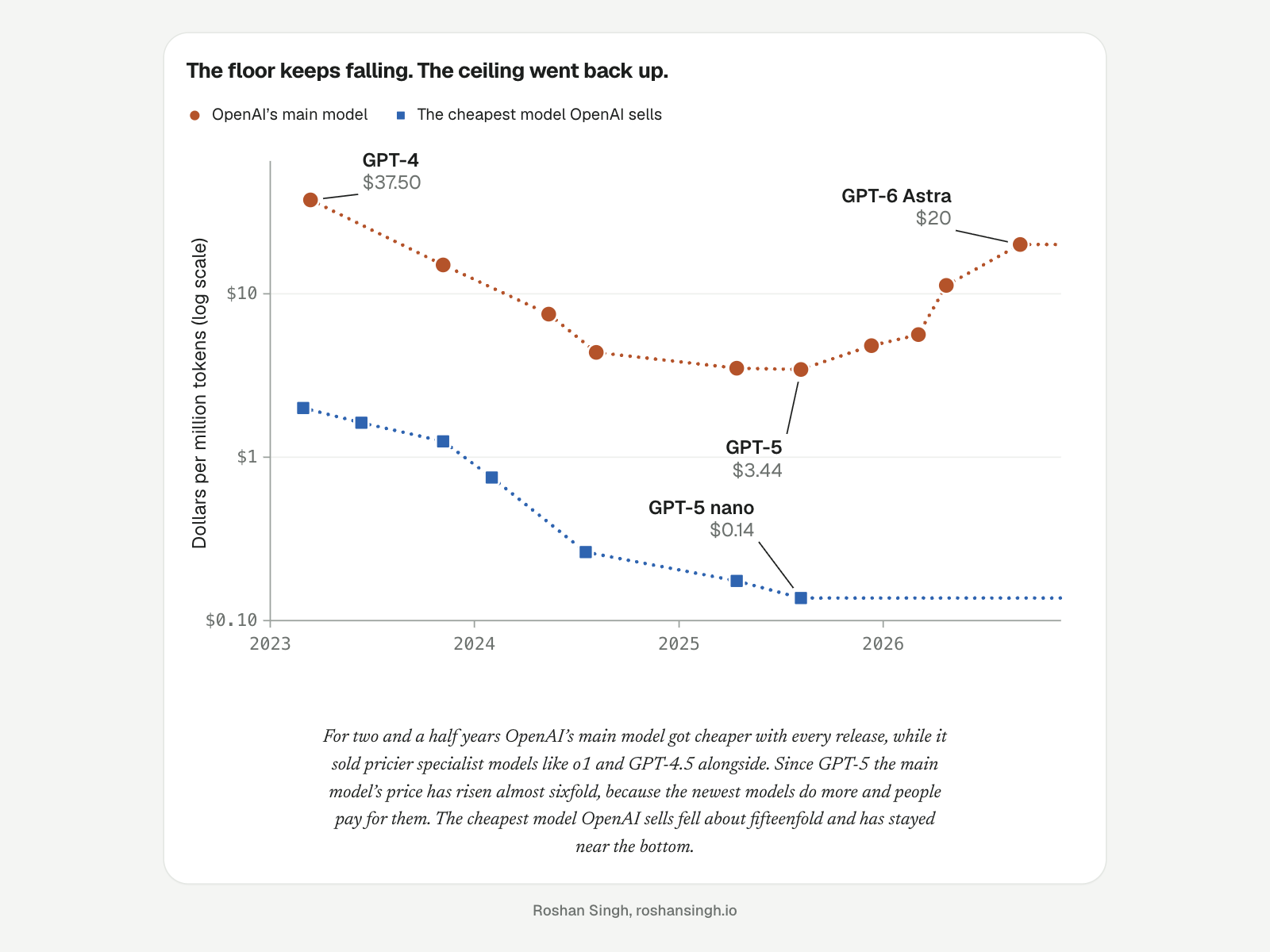
GPT-4-level intelligence now costs almost nothing, and hardly anyone settles for it. ChatGPT dropped GPT-4 itself in April 2025.6 The labs know this, and they price the top of the range for it.
- OpenAI’s main model
- The cheapest model OpenAI sells
Sources and numbers
OpenAI list prices on each release, blended three parts input to one part output. Main model: GPT-4, GPT-4 Turbo, GPT-4o, GPT-4.1, GPT-5, GPT-5.2, GPT-5.4, GPT-5.5, GPT-6 Astra. Pricier specialist and preview models, such as o1 and GPT-4.5, are left out. Cheapest: GPT-3.5 Turbo, GPT-4o mini, GPT-4.1 nano, GPT-5 nano, on sale until 11 December 2026.
| Date | Model | Input | Output | Blended |
|---|---|---|---|---|
| Mar 2023 | GPT-3.5 Turbo | $2 | $2 | $2 |
| Mar 2023 | GPT-4 | $30 | $60 | $37.50 |
| Jun 2023 | GPT-3.5 Turbo | $1.50 | $2 | $1.63 |
| Nov 2023 | GPT-4 Turbo | $10 | $30 | $15 |
| Nov 2023 | GPT-3.5 Turbo | $1 | $2 | $1.25 |
| Feb 2024 | GPT-3.5 Turbo | $0.50 | $1.50 | $0.75 |
| May 2024 | GPT-4o | $5 | $15 | $7.50 |
| Jul 2024 | GPT-4o mini | $0.15 | $0.60 | $0.26 |
| Aug 2024 | GPT-4o | $2.50 | $10 | $4.38 |
| Apr 2025 | GPT-4.1 | $2 | $8 | $3.50 |
| Apr 2025 | GPT-4.1 nano | $0.10 | $0.40 | $0.18 |
| Aug 2025 | GPT-5 | $1.25 | $10 | $3.44 |
| Aug 2025 | GPT-5 nano | $0.05 | $0.40 | $0.14 |
| Dec 2025 | GPT-5.2 | $1.75 | $14 | $4.81 |
| Mar 2026 | GPT-5.4 | $2.50 | $15 | $5.63 |
| Apr 2026 | GPT-5.5 | $5 | $30 | $11.25 |
| Sep 2026 | GPT-6 Astra | $10 | $50 | $20 |
It isn’t only OpenAI. Anthropic’s Claude Fable 5 launched at $10 per million input tokens in June 2026, twice the price of Opus, and Google says Gemini 4 Argon will double in price on 1 December. Even the cheap lines sometimes climb: Claude 3.5 Haiku cost four times what Claude 3 Haiku did, and Gemini 3.5 Flash cost three times its predecessor.14
We want it to think
Newer models work through a problem before they answer, writing out pages of reasoning you never see, and you pay for every word of it. When Google moved from Gemini 2.0 Flash to 2.5 Flash with thinking switched on, the new model used about seventeen times as many tokens on Artificial Analysis’s tests, and each one cost more, so the same tests cost about 150 times as much.15 A cheap price per token means little when every answer takes seventeen times as many.
We want it to work for hours
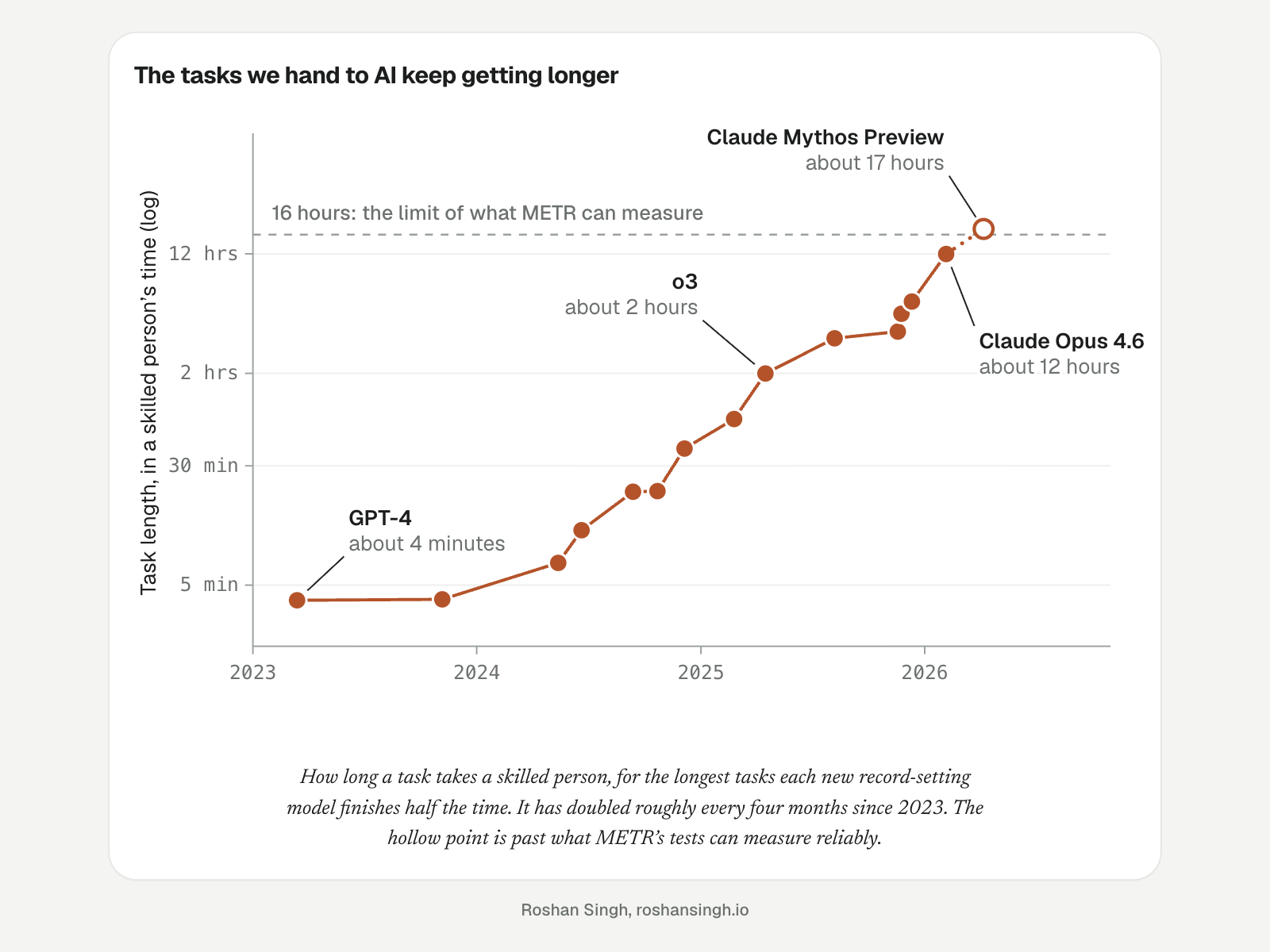
In 2023 we asked AI for a paragraph. Now we hand it work that would take a skilled person most of a day. METR, a research group that tests this, measures the longest task a model finishes half the time. For GPT-4 it was about four minutes. For Claude Opus 4.6, in February 2026, it was about twelve hours.16
Sources and numbers
METR, Time Horizon 1.1, last updated 8 September 2026. METR notes this is not the same as how long a model can work on its own, and that results above 16 hours are unreliable with its current tasks. By that update METR had not published results for newer models, such as Claude Opus 5.5 or GPT-6.
| Model | Released | Task length (50% success) |
|---|---|---|
| GPT-4 | Mar 2023 | 4 min |
| GPT-4 Turbo | Nov 2023 | 4 min |
| GPT-4o | May 2024 | 7 min |
| Claude 3.5 Sonnet | Jun 2024 | 11 min |
| o1-preview | Sep 2024 | 20 min |
| Claude 3.5 Sonnet (upgraded) | Oct 2024 | 21 min |
| o1 | Dec 2024 | 39 min |
| Claude 3.7 Sonnet | Feb 2025 | 1 hour |
| o3 | Apr 2025 | 2 hours |
| GPT-5 | Aug 2025 | 3.4 hours |
| Gemini 3 Pro | Nov 2025 | 3.7 hours |
| Claude Opus 4.5 | Nov 2025 | 4.9 hours |
| GPT-5.2 | Dec 2025 | 5.9 hours |
| Claude Opus 4.6 | Feb 2026 | 12 hours |
| Claude Mythos Preview (early) | Apr 2026 | 17 hours |
Longer tasks eat tokens. An agent fixing a bug reads files, runs the tests, tries again and reads more, so one request from us becomes hundreds of calls to the model.
We want it everywhere
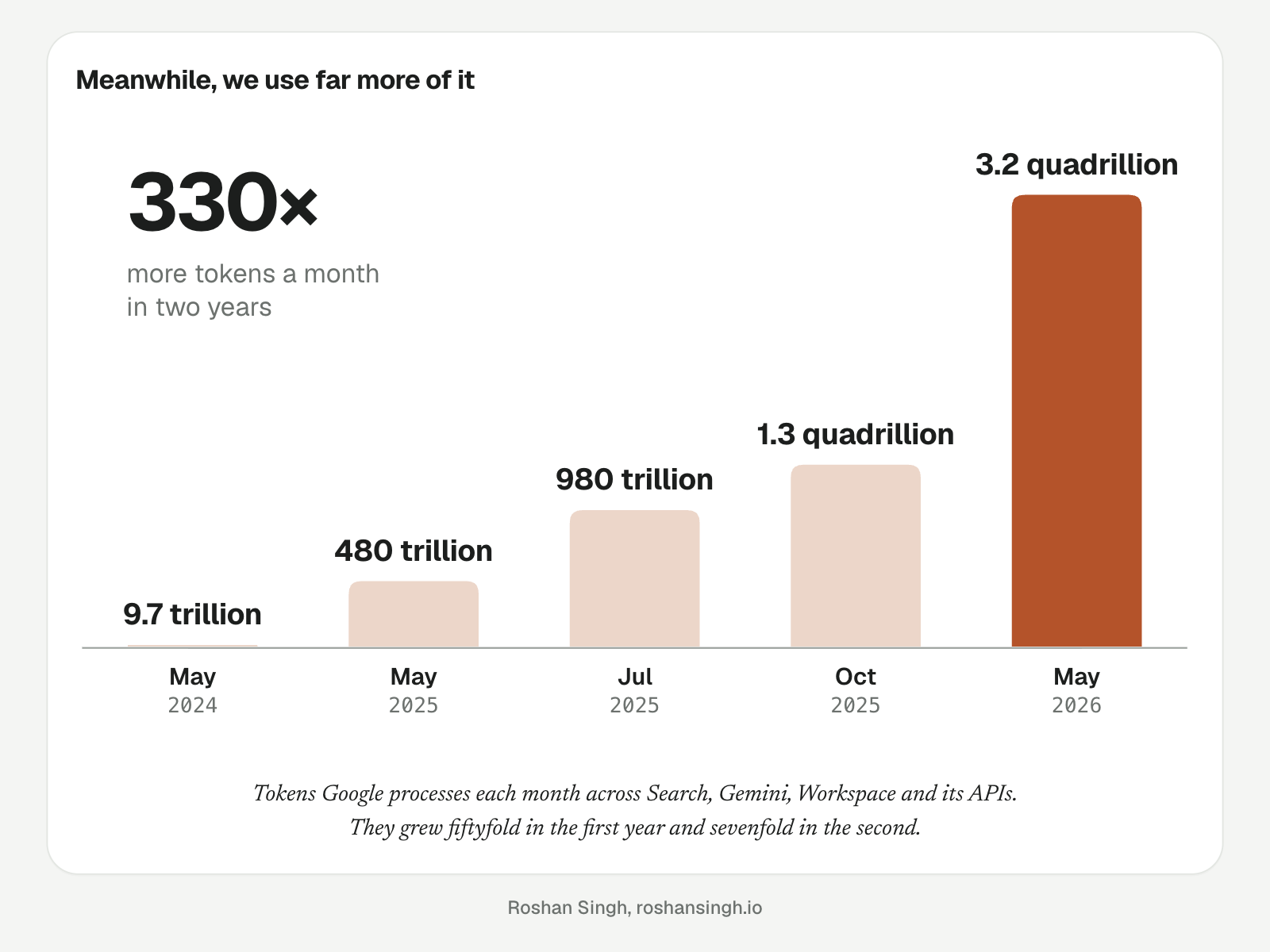
AI is now inside search results, email, documents and phones. Google says 2.5 billion people a month see its AI summaries in Search, far more than the roughly one billion who use the Gemini app.17
Sources and numbers
Google: I/O 2025 and 2026 keynotes; Alphabet Q2 and Q3 2025 earnings remarks. A token is about three quarters of an English word.
| Month | Tokens processed |
|---|---|
| May 2024 | 9.7 trillion |
| May 2025 | 480 trillion |
| Jul 2025 | 980 trillion |
| Oct 2025 | 1,300 trillion |
| May 2026 | 3,200 trillion |
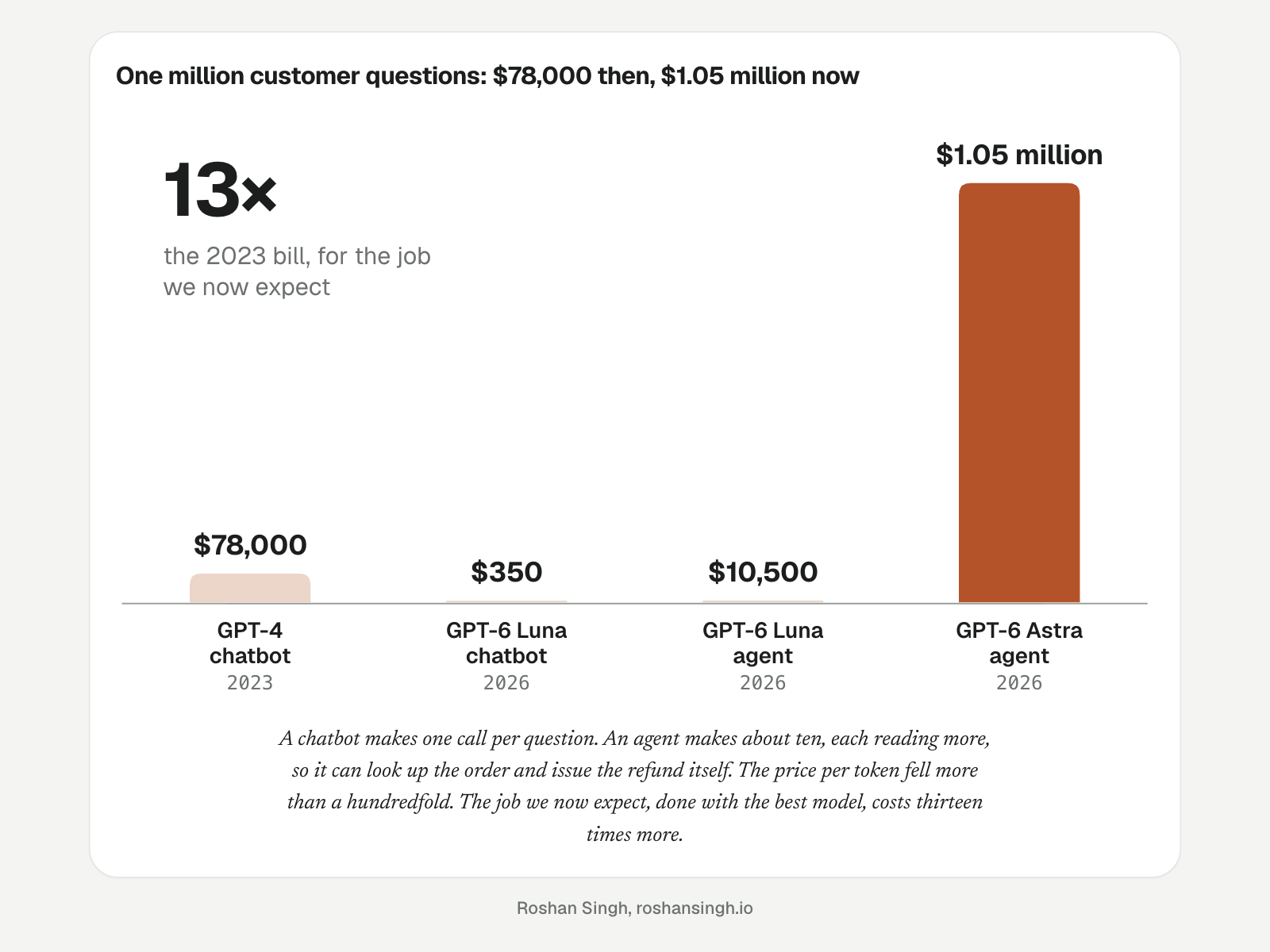
Put those together and the bill rises while the price collapses. Take one job, answering a million customer questions, and do it the way we did in 2023 and the way we want it done now.
Sources and numbers
OpenAI list prices. Assumptions, illustrative rather than measured: a chatbot answer reads 2,000 tokens and writes 300; an agent makes 10 calls per ticket, each reading 8,000 tokens and writing 500.
| Setup | Year | Cost for a million questions |
|---|---|---|
| GPT-4 chatbot | 2023 | $78,000 |
| GPT-6 Luna chatbot | 2026 | $350 |
| GPT-6 Luna agent | 2026 | $10,500 |
| GPT-6 Astra agent | 2026 | $1.05 million |
That is how Simon Willison’s $200 of subscriptions came to use $2,180 worth of tokens in a month. Gartner predicts that by 2028 companies will spend more on AI coding per developer than the average developer’s salary.18 That isn’t AI getting more expensive. It’s us asking more of it.
The fine print
Same price, smaller pack. Claude Opus 4.7 kept its list price, but a new way of cutting text into tokens turned the same English text into about 40% more tokens in Simon Willison’s tests. Anthropic itself says up to 35%.19 Shrinkflation, applied to words.
Cheap doesn’t always last. In August 2026 DeepSeek raised the price of its Flash model about threefold for input and almost fivefold for output at peak hours.20 Even off-peak, DeepSeek’s cheapest model now costs more than GPT-6 Luna.
Flat plans were a subsidy. “Unlimited” plans are becoming usage bills and weekly limits; GitHub moved its Copilot plans to usage billing on 1 June 2026.21
Cheap per answer, not in total. By May 2025 a typical Gemini prompt used about 0.24 watt-hours, 33 times less than a year earlier, yet the IEA expects data centres’ electricity use to roughly double between 2025 and 2030, to about 950 terawatt-hours, more than all of Japan uses today.22
What this looks like from India
Picture a helpline that answers farmers’ questions about crops, weather and prices, in Hindi, on WhatsApp. Each answer reads a few thousand tokens (the question, the conversation so far, the local advisories) and writes a few hundred. At GPT-4’s 2023 prices, one answer would have cost about ₹11. At today’s prices for a far better model, it costs about five paise. If a million farmers asked ten questions a month, that is the difference between about ₹11 crore a month and about ₹5 lakh.23 In 2023 that was out of reach for almost anyone. Today a small team could afford it.
Three more things look different from here.
Indian languages pay a tax. The same sentence in Malayalam or Tamil is cut into more tokens than in English, so it costs more. On OpenAI’s older tokenizer, Indian languages needed about eight times the tokens of English on average, and Malayalam thirteen. OpenAI’s newer tokenizer cut the average to about 2.1 times, and Bengali still needs roughly twice as many tokens as English.24
“Cheap” depends on where you stand. A $20 plan is about 0.3% of America’s monthly GDP per person, and about 9% of India’s.25 Falling prices matter more here than anywhere.
We have seen this film. Mobile data in India fell from about ₹269 a gigabyte in 2014 to about ₹10 by 2022. We didn’t save the difference; we went from barely using data to about 31 gigabytes a month each. And once the price war ended, tariffs went up again in 2024.26 OpenAI’s free year of ChatGPT Go for Indian users began on 4 November 2025, so the first renewals at ₹399 a month start in November 2026.27
What to do with this
If you build software, plan for what today’s best model does to cost about a tenth as much within a year, and for your usage to grow faster than that. The skill that matters now is routing: send each step to the cheapest model that is good enough, and save the expensive one for the steps that need it.
If you buy it, decide whether you need the newest level or a known one. A known level of intelligence is close to free. The very top is getting pricier.
For everyone else, the question isn’t whether AI is getting cheaper. It is. The question is what we will ask of it next.
Intelligence is getting cheaper every month. What we want from it is growing faster. Only the second shows up on the bill.
Sources and method27 sources, the data and how the charts were made
Prices are list prices from each lab’s pricing page or launch post on the date shown, using Wayback Machine snapshots for older pages, blended three parts input to one part output, for 148 model versions from 13 labs. Open-weight models are priced at their maker’s API or the cheapest of four big hosts (Together, Fireworks, DeepInfra and Groq), whichever is lower, within about a month of release; free tiers are left out. Benchmark scores are Epoch AI’s independent runs (GPQA Diamond and the Epoch Capabilities Index, CC BY), at each model’s best published setting. The chart data and the script that draws the charts are available on request.
- Prices: each lab’s pricing pages and launch posts, and for open-weight models the cheapest big host, mostly from Wayback captures. QwQ-32B: DeepInfra, 9 April 2025, $0.15 and $0.20 per million input and output tokens. Qwen3.7-Flash: Alibaba Cloud International, August 2026, $0.03 and $0.13, for prompts up to 32,000 tokens. Scores: Epoch AI benchmarking data, retrieved 29 October 2026. GPQA’s authors report that PhD experts scored about 65% on the full question set in their own fields.
- Simon Willison, 27 May 2026.
- Uber and Salesforce: Fortune, 28 May 2026: Uber “burned through its entire 2026 ‘token budget’ in just the first four months of the year”; Salesforce’s Anthropic bill “will be about $300 million this year”.
- Epoch AI uses the same 3:1 blend in its price tracking.
- A 300-page book is about 90,000 words. Proofreading means reading all of it and writing it back corrected: about 120,000 tokens in and 120,000 out. GPT-4: 0.12 × $30 + 0.12 × $60 = $10.80. GPT-6 Luna: 0.12 × $0.10 + 0.12 × $0.50 = $0.07. List prices from OpenAI, before any hidden reasoning: if GPT-6 Luna thinks before it writes, every 100,000 words of thinking adds about seven cents more.
- Menlo Ventures, 2025 Mid-Year LLM Market Update, July 2025: “builders don’t capture savings by using older models”; within a month of Claude 4’s release, Claude 3.5 Sonnet’s share of Anthropic users fell from 83% to 16%. GPT-4 left ChatGPT on 30 April 2025 (TechCrunch).
- Luke Emberson and David Roodman, The plunging price of thought, Epoch AI, 22 September 2026.
- DeepSeek-V3 technical report, December 2024; see Ben Thompson, DeepSeek FAQ, Stratechery, 27 January 2025.
- OpenAI API pricing: cached input is billed at 10% of the input price on the GPT-5 family.
- DeepSeek R1 launched at $0.55 and $2.19 per million input and output tokens, against o1’s $15 and $60. Nvidia: Bloomberg, 27 January 2025. o3: Simon Willison, 10 June 2025.
- DeepInfra, gpt-oss-20b, captured 6 August 2025: “$0.04/$0.16 in/out Mtoken”.
- William Stanley Jevons, The Coal Question (1865), in the chapter “Of the Economy of Fuel”.
- Roger Fouquet and Peter Pearson, “Seven centuries of energy services”, The Energy Journal, 2006: by 2000 lighting cost “less than one three thousandth of its 1800 value” and use per person was 6,500 times greater.
- Anthropic, Claude Fable 5; Google’s Gemini API pricing on Gemini 4 Argon ($2 per million input tokens through 30 November 2026, $4 from 1 December); Simon Willison on Gemini 3.5 Flash; TechCrunch on Claude 3.5 Haiku, 4 November 2024.
- The Decoder, citing Artificial Analysis, 10 May 2025.
- METR, Time Horizon 1.1 results, 8 September 2026: 4.0 minutes for GPT-4, 12.0 hours for Claude Opus 4.6, and a doubling time of about 129 days since 2023.
- Sundar Pichai, Google I/O 2026: 2.5 billion monthly users of AI Overviews. Gemini app: “now at one billion users”, Alphabet Q3 2026 earnings remarks, 28 October 2026.
- Gartner, press release, 24 June 2026.
- Simon Willison on Opus 4.7 (1.46 times the tokens on an English prompt, 1.08 on a PDF) and his token count table (1.42 on English); Anthropic gives a range of about 1.0 to 1.35.
- DeepSeek, API pricing update, 13 August 2026, effective 16 August: V4-Flash went from $0.14 and $0.28 per million input and output tokens to $0.44 and $1.32 at peak hours ($0.22 and $0.66 off-peak).
- GitHub changelog, 27 April 2026.
- Google, Measuring the environmental impact of AI inference, August 2025; International Energy Agency, Key Questions on Energy and AI, April 2026 (485 TWh in 2025 to 950 TWh in 2030), and Energy and AI, April 2025, which put 945 TWh at “slightly more than Japan’s total electricity consumption today”.
- An illustration, not a real service: 3,000 tokens in and 500 out per answer, before any hidden reasoning; GPT-4 at $30 and $60 per million input and output tokens, GPT-6 Luna at $0.10 and $0.50; about ₹95 to the dollar, the October 2026 rate. GPT-4: $0.12 an answer. GPT-6 Luna: $0.00055.
- Priyansh Srivastava, The Tokenizer Tax, July 2026; Avijit Roy and others, Measuring the Tokenization Premium, August 2026.
- World Bank GDP per person, 2025: about $225 a month in India and $7,500 in the US. An average, not a typical income.
- Data price per gigabyte, 2014 and March 2022: BOOM; Nokia MBiT Index 2026; tariff rises of July 2024.
- OpenAI help centre, ChatGPT Go promotion (India).